
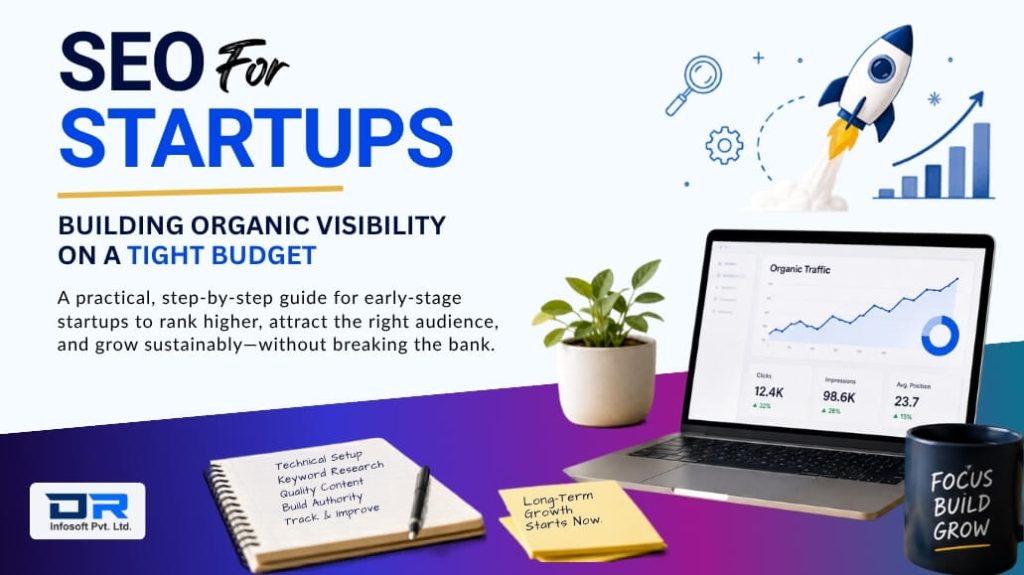
Most startups can’t afford to spend thousands of dollars a month on paid ads and hope for the best. The budget is tight, the team is small, and every dollar has to earn its keep. Which is exactly why SEO is so effective for early-stage companies — because the work you do today continues to pay dividends months and sometimes years later, with no recurring ad spend attached to it.
But SEO for a startup is different than SEO for an established brand with a large content team and a domain that’s been around for 10 years. You’re starting from scratch, and you’re up against sites that already have authority. You probably don’t have time to do everything at once. So the goal here is not to do all the things. The aim is to do the right things, in the right order, with the resources you actually have.
Here is how to build real organic visibility as a startup, without burning through money you do not have.
1. Understand That SEO Is a Long Game, But It Starts Today
It’s worth saying this right up front, because a lot of founders get frustrated when they publish a few blog posts and nothing happens. SEO is time-consuming. New domains take even longer because search engines want to see that your site is consistent, trustworthy, and worthy of ranking before they will start sending you traffic.
That doesn’t mean the results are years off. With the right strategy, you can start to see movement on the lower-competition topics in three to six months. The key is not to wait until you feel “ready” to start. Every week you put it off is a week of compounding you’re leaving on the table. Plant the seeds now, even if it takes a while for the garden to grow.
2. Get Your Technical Foundation Right First
Before you create a single piece of content, ensure your website is free from basic technical issues that will hamper everything. You don’t have to do a deep technical audit right away, but there are a few things you’ll want to check early on.
Ensure your site loads reasonably fast on mobile. Make sure it is HTTPS. Ensure Google can actually crawl and index your pages — check Google Search Console (it’s free) and see if there are any coverage errors. Set up a clean URL structure from the start. Changing it later, after you have published content, creates redirect headaches.
If you’re on WordPress, Webflow, or any popular CMS, the tools to handle this are either built-in or free to acquire. You don’t need to hire a developer for basic technical setup. What you do need is not to ignore it, because a site with indexing problems or a three-second load time on mobile is going to have a tough time, no matter how good your content is.
You may also like to read: Technical SEO Checklist for WordPress Websites in 2026
3. Do Keyword Research Like a Startup, Not a Big Brand
Big brands target high-volume competitive keywords because they already have the domain authority to rank for them. You do not—not yet. If you’re a new SaaS company, trying to rank for “project management software” is like stepping into the ring with a boxer twice your size. You’re not going to win. You’re going to spend a lot of energy trying.
The better move is to find keywords that have meaningful search volume, but a lot lower competition. These are often referred to as “long-tail” keywords and are usually more specific. Instead of “project management software”, target “project management software for remote design teams” or “best way to manage client projects without a dedicated PM”. These get fewer searches, but the people who do search for them are often closer to making a decision, and you can actually rank for them.
You can find these opportunities using free tools like Google Search Console, Google’s autocomplete suggestions, and the “People also ask” boxes. Ahrefs and Semrush both offer paid plans, but they also have limited free tiers that can be very helpful for early-stage research. Ubersuggest has a decent free plan for startups just getting started.
Be wary of keywords where the first page of Google is filled with generic blog posts from content farms rather than authoritative industry sites. That’s a gap you can fill with something better.
4. Develop a Content Strategy Around What Your Customers Actually Ask
The best content for a startup is not content about your product. It is content that answers the real questions your potential customers are already asking, even before they know your product exists.
Think about the path a person takes before buying what you sell. First, what problems are they looking for? What comparisons are they drawing? What words are they using alongside your solution? Map out that journey, and create content that meets them at every step.
If you sell accounting software for freelancers, you could create content such as “how to invoice clients as a freelancer,” “what expenses can freelancers write off,” or “how to set aside money for taxes when you are self-employed.” None of these articles is directly about your software, but they attract the exact kind of people who will eventually need it.
This method also positions you to be a helpful, knowledgeable presence in your space — building trust with readers and signaling relevance to search engines simultaneously.
Also Read: How to Write Website Content That Can Rank Even on AI Platforms
5. Publish Less, But Publish Better
One of the biggest mistakes startups make with their content is publishing too much too quickly, without putting enough into each piece. They crank out short, surface-level articles to meet a posting schedule and then wonder why nothing ranks.
Thin content in 2026 is not only unhelpful, but it also works against you. Google has gotten pretty good at knowing when a piece of content is actually helping the reader, and when it’s just taking up space with words. Five 400-word thrown-together posts aren’t going to beat out one well-researched, genuinely useful 1500-word article nearly every time.
As a startup with limited resources, don’t churn out something every day. Publish one or two strong pieces per week. Do your research. Add original insight where possible. Use real examples. Make sure the structure is easy to read. At this point, the quality signal is more important than the frequency signal.
Also Read: Writing with Clarity: 5 Simple Tips for Making Complex Ideas Easy to Understand
6. Target Topics Where You Have a Genuine Edge
This is one of the biggest advantages startups have that is not utilized. You are close to your industry. You’re always in touch with customers. You know the exact pain points in your niche better than any general content writer ever could. Use it.
Write about things only someone who is really in the trenches would know. If you have your own product, share data from that. Document real processes, real workflows, real mistakes you made, and what you learned. Those are the sorts of things bigger, more distant companies can’t easily replicate, and that tend to get links naturally because people actually find them useful and share them.
Original research and proprietary data are especially powerful for link building, which leads us to the next point.
7. Build Links Without Paying for Them
Backlinks, or links from other websites to yours, continue to be one of the strongest ranking signals that Google uses. As a new site, it is really hard to get good ones, but not impossible, and you don’t need to pay for them to see results.
Do what is easy, do what is cheap. Get your business listed in relevant directories and review sites for your industry. Get your startup featured in local business publications or startup-centric media outlets like TechCrunch, Indie Hackers, or Product Hunt — many of these will cover new companies for free if you reach out with something interesting to say.
Another method that still works when done right is guest posting on reputable blogs in your niche. The trick is to pitch topics that are actually useful to that blog’s audience, not just a thinly disguised advertisement for your startup. Write something great, add a link or two back to relevant pages on your site, and you have a backlink plus exposure to a new audience.
Links are also naturally generated by original research and data-driven content. If you publish a well-designed survey, a unique data set, or a study that reveals something surprising about your industry, other writers will cite and link to it when they cover the topic. It takes more effort up front, but a single piece like this can generate dozens of links over time.
Also Read: Editorial Links: Benefits and How to Get Them in 2026
8. Tap Your Existing Network Early
Most people don’t realize how important the first few weeks are after you publish a new piece of content. Content that has early engagement — clicks, shares, time on page — is likely to see a boost in search rankings. Content that sits for a month with no visitors sends a signal to search engines that nobody found it useful.
Share any new content with your existing network. Share it in relevant Slack communities, LinkedIn groups, Reddit threads where it makes sense, and niche forums in your industry. Email it to your subscribers, if you have any. Have team members and advisors distribute it. This initial traffic is not going to be huge, but it sends the right signals, and sometimes will get you unexpected links from people who find your content useful and share it on their own blogs or social accounts.
9. Do Not Ignore Local SEO if It Applies to You
If your startup caters to a specific geographic area or has a physical presence, local SEO is one of the fastest ways to get visible with very little competition. Fully optimize your Google Business Profile by completing all fields, uploading photos, soliciting reviews, and regularly posting updates. Make sure that your name, address, and phone number are consistent across all directories where you are listed.
Local search results often appear prominently above organic results, and many small markets have almost no competition in them. A handful of well-optimized local pages + a healthy Google Business Profile can get you in front of potential customers in your city faster than a long content strategy ever will.
10. Track What Actually Matters
Many startup founders obsess over keyword rankings and forget to ask themselves whether any of this is actually driving business results. Rankings are a good first sign, but they are not the final goal.
Implement Google Analytics 4 and Google Search Console from the beginning. Track which pages are getting organic traffic, which search terms are bringing people to your site, and most importantly, what those visitors are doing once they land on your site. Are they subscribing? Are they reading more? Or, are they going right away?
This data tells you what is working and what needs to change. Double down on the topics and formats that are sending engaged visitors. Refine and revisit the pages that get traffic but don’t convert. SEO without measurement is guesswork with extra steps.
11. Edit Old Content Before Creating New Content
One of the highest return activities you can do six months or so into publishing is to go back and improve what you’ve already got, rather than constantly creating something new. A post ranking on page 2 of Google for a relevant keyword is often much closer to page 1 than you think, and sometimes all it needs is a few updates, some additional depth, better internal links, or a refreshed title.
This is especially helpful for startups because it leverages what you already have, without the same resource investment as building from scratch. Audit your top pages every quarter and ask if they can be improved in a meaningful way.
12. Be Consistent and Ignore the Noise
What works today may not work tomorrow, and there’s always some new tactic being touted as the one that will finally get your site to rank. Most of it is just noise. Even as algorithms have become more sophisticated, the fundamentals have not changed: creating genuinely useful content, earning quality links, maintaining a technically sound site, and building a site that real people find valuable.
The winners in SEO are almost never the startups that come up with some clever trick. They are the ones who showed up week after week, created content that actually helped their audience, and kept improving their site month after month, even when the results were slow to come.
You’re building something that’s compounding. The traffic of month six is the basis for month twelve. You get links this year that make next year’s stuff easier to rank. And unlike paid advertising, none of it disappears the moment you stop paying for it.
That is the real benefit of organic search for a startup — and it is worth every bit of the patience it takes.