
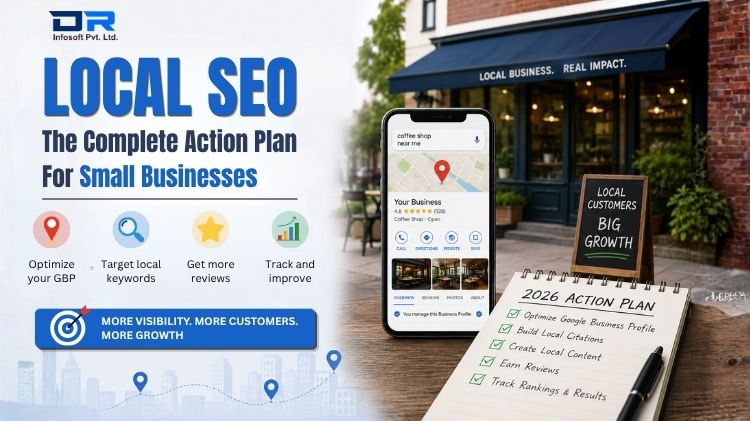
Running a small business is tough enough without having to wonder if potential customers can even find you online. You may have the best restaurant in Connaught Place in Delhi, the most trustworthy moving company in Gurgaon Sector 56, or the best boutique in HSR Layout in Bengaluru, but if you are not appearing when people are searching for services in your area, you are invisible.
Local SEO isn’t rocket science, but it does require consistent effort and a clear understanding of what really moves the needle. In this guide, we’re going to cover everything you need to rank higher in local searches all across India’s metro cities, attract more walk-ins to your store, and convert online searches into real customers.
Why Local SEO Matters More in India Than You Think
India is home to some of the world’s fastest-growing metro cities, with millions of people searching online every day for nearby services and businesses. If a man is looking for a gym in Mumbai Andheri West, he is not going to travel across the city for one in Navi Mumbai. If a bride is searching for a makeup artist in Fraser Town, Bengaluru, she is unlikely to book someone based hours away in another part of the city. That’s where local SEO becomes your greatest competitive advantage.
When people search for services in their area, Google favors businesses with strong local signals and geographic relevance. Your competitor down the street has an optimized Google Business Profile, and you don’t. They’re getting the customers that should have been yours.
The data support this. Research shows that 46% of all Google searches are for something local. That means almost half of all searches are people looking for something nearby. Importantly, 76% of people who search on their smartphone for something nearby visit a business within a day. These are not casual browsers. These are people who want to spend.
Local SEO is no longer an option for small businesses operating in India’s metro cities. It is a matter of survival.
How to Correctly Set Up Your Google Business Profile
Your Google Business Profile (formerly Google My Business) is the most important single factor in local SEO. It also boosts a website’s overall SEO, ensuring better ranking in the organic search results. When someone searches for your service in Delhi NCR, Google pulls data directly from your profile to show in search results and Google Maps.
Most businesses set up a profile and then forget about it. That’s not right. Your profile needs to be complete, accurate, and updated regularly.
Claim or Build Your Profile
Begin by claiming or creating your profile on Google Business Profile.
Use your exact business name, as it appears on your storefront and official documents. Don’t keyword-stuff your business name. Google has put a halt to this practice, and it can result in your listing being suspended.
If you are “Sharma Electronics”, then do not change your name to “Sharma Electronics Best TV Shop Lajpat Nagar Delhi”.
Select the Right Business Category for Your Business
Google allows you to choose a main category and several sub-categories. Your ranking is most affected by your primary category. If you’re a bakery, choose “Bakery” as your main category. Not “Restaurant” or “Cafe”. You can add those as secondary categories if applicable.
Fill Out All Profile Fields
Include your full address, phone number, website, business hours, and service area. If you are catering to customers in multiple locations in Mumbai, mention the areas.
If you are a home cleaning service situated in Navi Mumbai but provide services in Mumbai, Thane, and some parts of Panvel, state it.
Upload Best Quality Photos of Your Business
Google recommends a minimum of 10 photos, including exterior, interior, product, service, and team photos.
Businesses with photos get 42% more requests for directions and 35% more clicks to their websites.
Update these photos regularly. A bakery should be sharing fresh photos of new products, seasonal specials, and behind-the-scenes shots.
Write a Detailed Business Description
Make sure it explicitly explains what you do, who you serve, and what makes you different. You have 750 characters at your disposal. Use them well.
Mention your location naturally. Instead of “We are a salon”, write “We are a unisex salon in South Extension serving customers across South Delhi with premium hair and skin services”.
Include Appropriate Business Attributes
These are specific features, such as “wheelchair accessible,” “outdoor seating,” “free Wi-Fi,” or “women-led.” They help customers make smarter choices and improve your visibility in filtered searches.
Turn on Messaging
Let customers contact you directly from your profile. Many customers, particularly the younger crowd, prefer texting to calling. Keep your response rate good by replying to messages within 24 hours.
Regular Updates Post
Update your Google Business Profile regularly. These posts appear in your profile and can include offers, events, new products, or general updates.
At least post once a week. Restaurants need to have daily specials. A gym could show its class schedules or transformations of its members. A boutique has to share new arrivals and seasonal collections.
Stay Up-To-Date With Your Data
Most importantly, keep your data current. Update your hours immediately if you change them during festivals or if you add a new phone number. Confusing your customers with inconsistent information hurts your rankings.
How to Get More Google Reviews (Without Begging)
Reviews are the lifeblood of local search engine optimization. They communicate trust, boost rankings, and directly influence purchasing decisions. More reviews and higher ratings always provide businesses with a competitive advantage over businesses that have fewer reviews, even though they have better websites.
You need to have a system in place to get reviews in your city. You can’t just sit around and wait for customers to write reviews. Most happy customers never leave a review unless you ask them.
Make It Simple for Customers
First, keep it simple. Immediately follow up with positive customers by sending review links via WhatsApp or SMS. The longer you wait, the less your chance of getting a review. The time to ask is when a customer has just told you how great your service was.
Use a URL shortener to create a short link to your Google review page. Send something like bit.ly/yourshopreviews instead of a long and complicated Google URL. It appears cleaner, and it has a better response rate.
Train Your Staff to Ask Naturally
This is especially important for service businesses like salons, clinics, and repair shops. When a customer thanks your team or tells them they are satisfied, your staff should reply, “We are so glad you are happy. Could you do us a quick favor and leave a Google review?” It really helps other people find us.
Avoid False Incentives
Never, ever incentivize reviews with freebies or discounts. Google does not permit this and may take down your reviews or penalize your profile. The aim must be to get real reviews by providing great service.
Reply to Every Review
Respond to all reviews, positive or negative. Thank customers who leave positive reviews and professionally handle concerns in negative reviews. Your responses show potential customers how you react to feedback. A 2-star review that a business responds to thoughtfully can be better than one that’s ignored.
Dealing with Negative Reviews
When responding to negative reviews, don’t get defensive. Recognize the issue, apologize if appropriate, and offer to resolve offline. For example, “We’re sorry your experience wasn’t as you expected. “Please call us at [number], and we will make this right. This demonstrates you care and provides an opportunity to turn a detractor into a promoter.
Regularly Review Monitors
Check your reviews regularly. Or you can set up Google alerts or use your Google Business Profile app to get notified when someone leaves a review. Reply within 24-48 hours while the conversation is fresh.
Handling Fake Reviews
If you get a fake negative review from a competitor or someone who wasn’t your client, report it to Google from your profile dashboard. If you can provide evidence, Google does take down fake reviews, but it can take weeks.
Consistency is Key
You want to build up a steady stream of new reviews, not a spike. 10 reviews in 2 months look more natural than 10 reviews in 1 week. It shows Google that your business is delivering good experiences all the time.
How to Create Localized Content That Ranks
Content is where most small businesses fumble. They create generic service pages that could be for any city in India and then wonder why they are not ranking for local searches.
Google favors companies that produce content directed at their local audience. This means creating blog posts, service pages, and guides that speak to people in your city.
Build Dedicated Location Pages
If you cover multiple areas, create dedicated location pages. For a plumbing service covering Delhi NCR, there should be separate pages for “Plumbing Services in Gurgaon”, “Plumbing Services in Noida”, and “Plumbing Services in Faridabad”. Every page has to have different content that is specific to that area and what their concerns are.
Avoid Copy-Paste Content
Don’t just change the name of the city and copy-paste the same stuff. That is thin content, and Google will ignore it. Instead, reference local landmarks, discuss area-specific problems, and use testimonials from area customers.
For example, a moving service page for Gurgaon can talk about common problems in DLF apartments or traffic issues in some sectors. A page for Noida could take up the issue of old buildings in sectors 15-22 or new buildings in Greater Noida West. This level of detail tells Google that your content is actually relevant to that location.
Create Blog Content Through Local Searches
Answer local questions with blog articles. Try Google’s “People Also Ask” or AnswerThePublic to find questions being asked by people in your city. A dermatologist might write, “Best Skincare Routine for Delhi Pollution” or “How Delhi Winter Affects Your Skin.” A restaurant might say, “Where to Find Authentic North Indian Food in Bandra, Mumbai” or “Best Family Restaurants in Hinjewadi, Pune for Birthday Celebrations”.
In these posts, refer to your business as a solution in a natural way, without sounding too promotional. The aim is to first add value and then promote.
Use Local Keywords Naturally
Instead of “best salon” write “best salon in Lajpat Nagar” or “affordable salon in South Delhi”. But don’t get carried away. For humans first, search engines second. If your content reads like keyword stuffing, people will leave, and Google will notice.
Build Neighborhood Guides
Develop area-specific resources and neighborhood guides. A real estate agency may say “Complete Guide to Living in Dwarka: Schools, Markets and Commute”. A gym could say “Best Outdoor Workout Parks in South Mumbai”. These guides create local traffic and help position your business as a resource for your community.
Add Schema Markup
Implement schema markup on your location pages. This is structured data that helps Google understand your content better. The LocalBusiness schema lets Google know exactly where you are, what services you offer, and how to reach you. Most WordPress SEO plugins, like Yoast or Rank Math, make this simple to implement.
Embed Google Maps
Add Google Maps to your location pages. This increases your physical presence and makes it easier for potential customers to find you. Make sure the address on your map is exactly the same as the address on your Google Business Profile.
Keep Your Content Up to Date
Keep your content current. A blog post in 2019 on “Best Cafes in Delhi NCR” is dated. Many of those cafés may be closed or changed. New content indicates to Google that your website is active and relevant.
Building Local Citations & Directory Listings
Citations are online references of your business name, address, and phone number (NAP) on other websites. They are votes of confidence that your business is legitimate and authentic. The more consistent your citations are across the web, the more Google will trust your business.
Start With Major Business Directories
Begin with the major Indian business directories: Justdial, Sulekha, IndiaMART, TradeIndia, and Asklaila. Fill out complete profiles on each platform with accurate information. Please use the same business name, address, and phone number in all places. Even slight differences like “Street” vs “St.” or different phone numbers can confuse Google and dilute your local SEO.
Submit to Industry-Specific Directories
Register your business in industry-specific directories. Zomato and Swiggy should list the restaurant. A doctor should have Practo and Lybrate. The tutor must be on UrbanPro and Superprof. These platforms are valuable citations that improve local rankings, not just marketing channels.
Join Local Community Platforms
There are lots of Facebook groups, WhatsApp communities, and local listing sites for neighborhoods. Add your listing on these platforms. They might not get huge traffic, but they add to your citation profile.
Claim Your Social Media Accounts
Even if you are not going to use social media platforms, create your business on them. Facebook, Instagram, LinkedIn, and Twitter profiles with consistent NAP details. Get a link to your website from these profiles.
Get Connected to Local Business Networks
Engage with local chambers of commerce, trade associations, and business networks. In Indian metros, there are many industry associations and local business groups. Many offer directory listings to their members. These are quality citations from authoritative local sources.
Check Your Citations Frequently
Regularly track your citations with tools like Moz Local, BrightLocal, or Whitespark. These tools search the web for mentions of your company and point out inconsistencies. Correct any incorrect information immediately.
Update Existing Data All Over
If you have moved or changed your phone number, change every citation. Old, incorrect citations hurt rankings because they send mixed signals to Google. It’s dull work, but it’s important work.
Steer Clear of Spammy Directories
Avoid directories that are of poor quality and are just for SEO purposes. Some websites scrape business information and create listings without permission. If you see your business on spammy sites with thin content and no real value, request that it be removed.
Optimizing for Mobile and Voice Search
India has one of the largest smartphone user bases in the world, and most local searches are now made on mobile devices. If your website is not mobile-friendly, you are losing potential customers every day.
What you want to focus on:
Mobile-Friendly Design
Test your site with Google’s Mobile-Friendly Test tool. It tells you just what needs fixing. Common problems include small text, clickable elements too close together, and content wider than the screen.
Fast Loading Speed
Ensure your website is fast on mobile. Compress the images, enable browser caching, and minify the code. Tools like Google PageSpeed Insights or GTmetrix can help you identify bottlenecks. Even a one-second delay in page load time can reduce conversions by 7%.
Click-to-Call Buttons
On mobile, people should be able to click your phone number and call you with one tap. Include a prominent click-to-call button on every page. The same applies to your address. Allow mobile users to open directions in Google Maps with a single tap.
Voice Search Optimization
Voice search is also growing rapidly in Indian metro cities. Now people search conversationally instead of typing short keywords. Instead of “plumber Mumbai,” users search “Where can I find a good plumber near me?”
To optimize for voice search, tune for question-based conversational queries. Create FAQ pages to answer common questions in natural language. “How much does it cost to hire packers and movers in Delhi?” or “Which salon in Pune is open on Sunday?” Add schema markup to your FAQ pages. This helps Google bring your answers right into search results and voice assistants.
Plus, focus on “near me” searches. These are pure gold for local businesses. Make sure your Google Business Profile is optimized. This is where Google pulls information from for “near me” queries. Suppose you are in Delhi’s Dwarka, and if you search for “gym near me”, Google will show you the list of gyms in Dwarka with complete profiles and good reviews.
How to Handle Your Online Reputation on Various Platforms
Your online reputation is more than just Google reviews. Businesses are being talked about on Instagram, Facebook, WhatsApp groups, and local community forums, so you need to be on top of your presence everywhere.
So, here is what you need to do:
If you get negative feedback, don’t panic or argue. Calm, solution-oriented responses are far more likely to build trust than attempts to suppress criticism. Customers respect when businesses admit their mistakes and try to make things better.
Tracking Results & Metrics That Matter
Local SEO is not a one-time job. You need to track performance and optimize what is working.
This is what you need to watch for:
Don’t review your data daily; check it monthly instead. Local SEO is a long game, but as you track consistently, you find out what is really driving customers to your business.
Local SEO Mistakes That Businesses Commonly Make
Even businesses that are doing local SEO often make mistakes that hurt their rankings and visibility. Here are the most common ones:
The Long-Term Local SEO Maintenance Strategy
Local SEO is not a one-off project. It requires continuous maintenance in order to maintain and improve your rankings.
Concluding Thoughts
Local SEO can seem overwhelming, especially for small businesses with limited time and resources. The good news is you don’t need to do it all at once. This guide has provided you with a good action plan to get started.
Sure, local SEO is competitive, but it’s one of the most reliable ways to grow a small business. Unlike paid advertising that stops working the moment you stop paying, local SEO builds compounding value over time. The work you do today will drive customers for months and years to come.
It’s not always the biggest or oldest businesses that win local search. They are those that are always there, add value, and make it easy for customers to find and choose them. Start using these strategies today, and in six months you’ll be wondering how you ever did business without them.