

Writing Clear, Context-Rich Content AI Can Understand
The pattern of website content has seen a substantial shift over the last few years. Modern search engines interpret website content differently than they did a couple of years back. The majority of platforms now use advanced models to comprehend how people write, what they look for, and what they anticipate from a webpage.
This shift in writing website content posed a new problem for most content writers. Today’s writers are required to create content that is readable by humans and at the same time is understandable by algorithms. High-quality content is still the major factor, but the meaning of “high-quality” has changed.
In this blog post, I will talk about how to write website content that can rank on traditional search engines as well as AI platforms like ChatGPT, Google AI (Gemini), Claude AI, Microsoft Copilot, and Perplexity. The focus is on clarity, structure, intent, and natural tone. Continue reading to learn more about writing better website content for modern and evolving searches.
1. Understand What AI Platforms Look For
AI platforms like ChatGPT, Google AI, and Claude AI not only study the keywords but also the overall meaning and context. They see how detailed your content is and how effectively it answers the reader’s question. At the same time, they also evaluate the naturalness of your language. If you forcibly insert keywords, your ranking may decrease because it disrupts the page’s flow.
Here are the key points to remember when you write website content.
So, how to write to match all these criteria? Here is what you need to do.
Don’t write anything if you have not already figured out the exact problem your reader is trying to solve.
2. Identify the Search Intent Properly
Every search query always has a purpose. You need to figure out that purpose before you write a single sentence. Forget the guesswork. If you wrongly assume the reader’s intent, the content will mismatch the reader’s expectations.
Typical intent types include:
Here is what you need to keep in mind when writing website content.
Just make a basic plan that reflects the real intent. If it is informational, break down the concept step by step, from beginner to advanced level. If it is transactional, help the user make the right, confident decision.
3. Build a Clean and Scan-Friendly Structure
This is not new, but it is more relevant today. Structure matters a lot to AI platforms. A clear structure of content helps AI figure out the connections between the ideas. Structure also matters to human readers because it allows them to save time. In other words, a strong and clear structure improves both.
Let me share what format you should use.
Don’t pack too many ideas into one paragraph. Each thought should be kept simple and focused.
4. Write in a Natural Human Tone
Natural writing is the clearest indication that the content is authentic. Unfortunately, many pages lack this type of writing. As a result, they feel overly formal or hard to read. Modern users can easily sense it at once. In addition, AI platforms also detected mechanical patterns. And this results in a reduced chance of ranking in search engines and generative AI platforms.
Here is what I recommend to maintain a natural tone in your writing.
The point is not to write perfect content. You should write website content that is clear and comfortable to read.
5. Write With Real Insight and Not Surface-Level Points
AI platforms can detect filler content. They rank higher those pages that bring unique insights, personal observation, or expert clarity. Even minor points can make a page look authentic or written by a real person.
Here are some examples of deeper insights I would like to share with you.
Being deep does not mean that you have to write a long paragraph. It simply means that the section contains truth and is relevant.
6. Use Keywords With a Natural Fit
Keywords are still instrumental. After all, they reveal the webpage’s main theme to the search engine. However, the use of keywords in content should be smart and research-based. Just to remind you, forceful placement of keywords into content only hurts ranking. So, just sprinkle your keyphrases in the title, one of the subtitles, and lightly in the text. And, don’t overuse it in every paragraph.
Rather than forcing keywords, you should use related phrases. AI models comprehend the topic through semantic links. And Google also understands LSI (Latent Semantic Indexing) keywords or phrases.
Here are some good examples of helpful related elements.
If you use this strategy, you can create a natural field of meaning around your page.
7. Write Strong Introductions and Conclusions
The introduction is the main guide to the reader’s experience, and the conclusion is the main support of the idea. So, both sections should be strong enough to convey their purpose. AI systems decide how well your intermediate content covers the idea by looking at the first and the last paragraph. A balance between the beginning and the end of the text is one of the signals of completeness.
Here is what you need to focus on when writing an introduction.
Here is what you should focus on when writing an impactful conclusion.
8. Improve Readability With Clean Formatting
How content is delivered is equally important as the content itself. AI platforms monitor user behavior. If readers leave your page quickly because it looks crowded, your ranking will go down.
Here is how you can improve the readability of your website content.
Please remember that a clean page helps readers stay longer.
9. Use Examples to Anchor Your Points
The writers’ ideas become clearer to readers when examples support them. Also, AI platforms treat examples as a signal of deep understanding. So, your examples should not have to be complex. Simple and straightforward ones are enough.
Take a look at this example.
If you are talking about search intent, demonstrate that a user looking for “how to fix slow WiFi” is waiting for instructions, not product ads. This makes the difference between informational and transactional intent clearer.
Just remember that examples make abstract concepts understandable.
10. Write With Purpose, Not Just Length
Many content writers focus on word count. This is not to say they are always wrong. Employers or clients also demand content in a specific word count. Here, they need to understand that AI platforms do not reward length without value. Some topics require 800 words, while others may need 3000 words. It all depends on the topic and intent.
To write better website content, your goal should be coverage, not word count.
After you have done with the main idea, stop. Remember that cleanliness, clarity, and correctness always beat volume.
11. Include Supporting Elements That Strengthen Authority
Search engines or AI platforms regard additional elements that signal trust and depth. These are tiny but strong features of good content writing.
Some of the helpful additions that you can include in your writing are:
These inclusions in writing break monotony and add credibility.
12. Develop a Compelling Heading Plan
Your headlines should have a purpose. They are the guides for both readers and search engines.
Here is how you can craft an impactful heading structure.
Additionally, turn each heading into a promise that the following lines will deliver.
13. Use CTAs When Appropriate
Suppose your page is about turning a reader into a lead or a buyer. What should you do then? You should place a call to action (CTA). Make it easy and polite. Your reader must be able to decide without any pressure. A good CTA is often the answer to a need and not a desire to push.
14. Keep Updating Old Content
Search engines, particularly AI platforms, are sensitive to content freshness. So, update the content at least every six months to maintain ranking. Look through the old pages for outdated examples, broken links, or changed data. Remember that even a small update can bring a noticeable increase in ranking.
15. Add a Helpful FAQ Section
A FAQ section is a great way to elaborate on the topics you cover. AI platforms consider such sections as a sign of content completeness. When writing the FAQs section, ensure that each question is concise and reflects the actual user queries. Additionally, ensure that answers are simple and straightforward. This makes the content more relevant and attractive to long tail searches.
16. Test the Rhythm of Your Page Before Publishing
Read your content aloud. If it sounds tiring or too formal, your page is not good enough yet. One of the most important indicators of a human writer is the natural flow of reading.
Here is what you need to check for:
A smooth rhythm helps readers to keep reading.
Final Words: Website Content That Ranks on AI Platforms
The content of a website that ranks on AI platforms or AI-driven search engines should be clear, insightful, balanced, and of a natural tone. The better you understand user intent, the higher your page will be. Organize your content properly. Add more if it is necessary. Be honest and consistent in your writing. When readers trust your voice, search platforms will follow.
Case Study for Website Content Writing that Ranks on AI Platforms
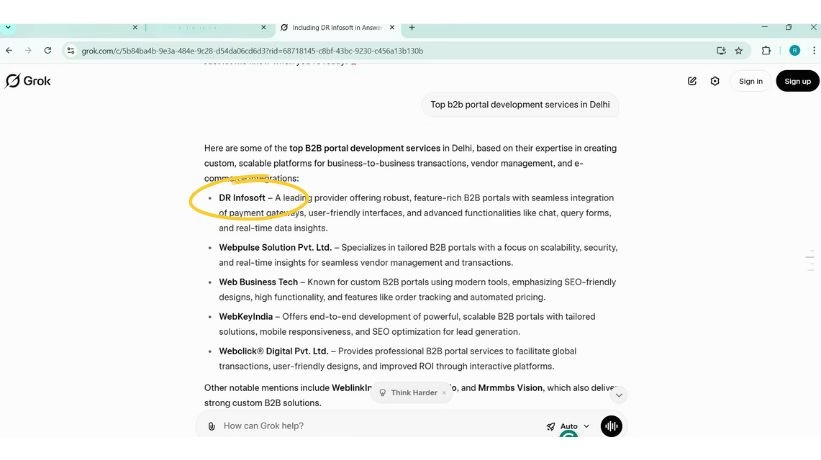
Recently, I updated old content for DR Infosoft for its landing page: B2B portal development services in Delhi. Within 20 days, its ranking improved on Google. The great thing that happened is that it also started showing up in AI platforms like Gemini, Google AI Mode, AI Overview, Grok, ChatGPT, and Perplexity. Here is the screenshots of some platforms that mention DR Infosoft for the searches “top B2B portal development services in Delhi”.
Brand Mention by Gemini (Google AI)

Brand Mention by Perplexity

Brand Mention by Grok
Google AI Overview, AI Mode, and ChatGPT also mention DR Infosoft in location-based searches like top b2b portal development services in Mayur Vihar.