
Learn how Answer Engine Optimization (AEO) helps your content appear directly in AI-powered search results. This guide covers what AEO is, how it differs from traditional SEO, and practical ways to optimize your content for modern answer-driven search. Let me go straightforward and talk about what Answer Engine Optimization (AEO) is.
What is Answer Engine Optimization (AEO)?
Answer Engine Optimization, or AEO, means structuring content so AI platforms can easily understand it and present it as a direct answer to user questions. In simple terms, traditional SEO gets your page to rank; AEO focuses on getting your content selected as the answer.”
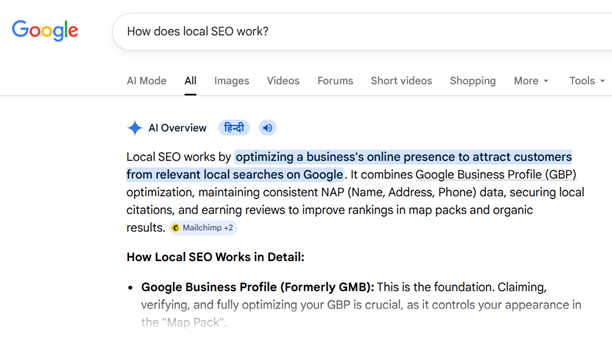
For example, you type into Google, “How does local SEO work?” Instead of showing only a list of websites, Google also presents a direct answer upfront under AI Overview. See the screenshot below.
Now, ask ChatGPT, “What is the best Travel CRM?” It directly presents you with a few options for the answer, without overwhelming you, unlike endless pages on search engines. Here is how it looks.
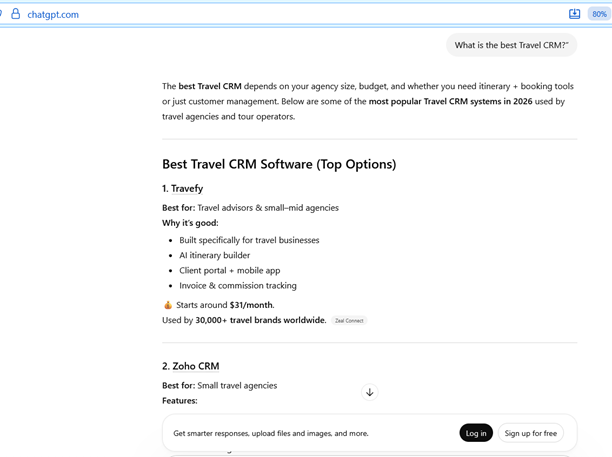
In both cases, AI systems scan many sources, pick the most useful points, and then show a simple answer.
And AEO focuses on helping your content become part of that response. It is not only about chasing keywords and backlinks. What matters more now is: Clarity, Accuracy, and Well-structured information. When your content explains a topic clearly, AI engines trust it as a reliable source.
What is an Answer Engine?
An answer engine is any AI-powered platform that delivers a direct response to a query, rather than a list of links. And you already use several of them daily.
Each platform has its own way of selecting and citing sources. AEO prepares your content for all of them.
How Did AEO Come About?
Search did not change overnight; it evolved in three distinct phases.
Phase 1: Keyword Search
In the early search era, users entered keywords, and search engines matched those keywords to pages. Rankings were mechanical and mostly manipulated. Any person can rank their site using tricks such as keyword stuffing and link schemes.
“The quality of the content was not as important as using the right words in the right way.”
Phase 2: Intent-Based SEO
Google introduced semantic search technologies such as RankBrain (2015) and BERT (2019). These updates shifted the emphasis from matching keywords to interpreting user intent.
“Relevance, context, and content quality became more important for ranking well.”
Phase 3: AI-Enhanced Answers
Nowadays, search engines use AI to provide summaries, answer boxes, and synthesized information. They don’t simply display ten blue links, but they also read the web on your behalf and provide you with instant answers.
This opens up new possibilities for what some marketers refer to as Answer Engine Optimization (AEO) — the optimization of content so that it can be accurately interpreted and referenced by AI-driven search.
This shift did not make SEO obsolete; it raised the bar. Content that once ranked now must be trustworthy, authoritative, and structured in a way that both humans and AI can understand.
What Makes AEO So Important in 2026?
These days, AEO is key for staying visible online because the way people search for information has completely changed. The surprising part? Most businesses are not yet up to date. Here is why AEO really matters.
Shift Toward Zero-Click Searches
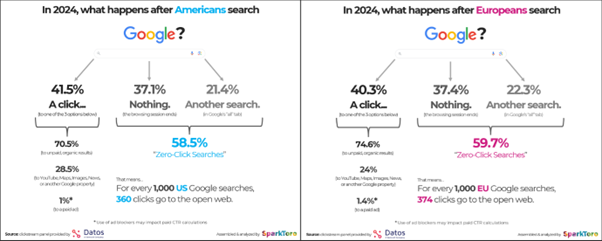
A 2024 SparkToro study analyzing Semrush’s Datos clickstream data shows 58.5% of US searches and 59.7% of EU searches now end without a single click to any website. No clicks. No traffic. No conversions. People get their answer right on the results page and move on.
Search for a keyword like “how SEO works” in Google. You will get a direct answer within the search interface, in the form of AI-generated summaries, like this.
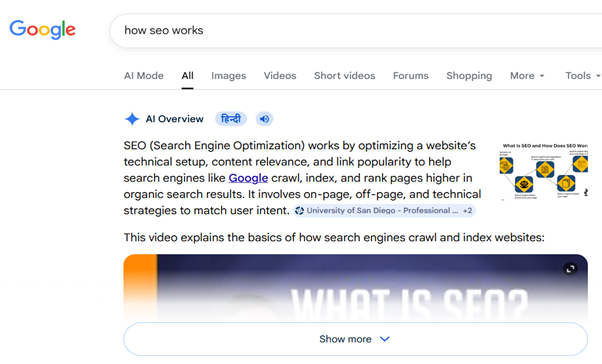
Besides Google AI Overviews, you may also find a direct answer to your query in the form of featured snippets and knowledge panels.
If your business totally relies on organic traffic or even on paid Google clicks, this is not a small fluctuation. It is a structural erosion of your primary marketing channel. You are losing more than half of your potential audience before they ever reach your site.
The Rapid Rise of AI Search Platforms
Google’s dominance in search is gradually being undermined by traditional rivals like Bing and Yandex. According to Statcounter, Google’s global search market share fell below 90% for the first time since 2015. Plus, AI tools are changing overall search behavior.
ChatGPT, for example, has become a mainstream research tool for 900 million weekly active users. Google AI Overviews are now accessible to almost 2 billion monthly searchers, and Perplexity AI processes 60-70 million daily queries according to recent usage statistics. Platforms such as Claude AI and Gemini are also gaining ground.
These tools are no longer experimental. They represent a genuine change in how young, higher-income, and more tech-savvy users search. The audience that most businesses want to reach is already searching differently.
Traditional Search Volume is Declining
According to a 2024 Gartner forecast, traditional search engine volume will decline by 25% by 2026 as more people use AI chatbots and virtual agents. A quarter of all search activity is shifting away from the environment that many businesses have optimized for years. Businesses that are flexible today will fill the gap – those that wait will struggle with a shrinking audience.
AEO Yields Higher-Quality Traffic
“Fewer clicks” does not mean “less business.” When a user reaches your site through a Google AI citation, he or she already knows who you are. The AI engine has pre-qualified them: your brand name comes across as trusted and authoritative: credibility you can’t buy with an ad.
Early industry data indicate that visitors arriving via AI citations have higher conversion rates than those from traditional organic channels.
The Early Movers Have a Compounding Advantage
AI models prefer to source from those that they have already cited. Once your content has been cited by an AI engine, the content will be more likely to be cited again for related queries and topics.
This creates a clear advantage for early adopters. Those who wait usually struggle to catch up later.
AEO Vs. SEO Vs. GEO – The Difference
As we have seen how AI search has evolved, we also have three different optimization fields. Though they are related, they are not the same, and intermixing them can lead to gaps that can be detrimental to your visibility.
Here is how they are different, and why you need all three.
Search Engine Optimization (SEO)
It helps your site have a better position in the traditional search engines. The goal is to receive value from Google or Bing search results. Key levers include keyword research, on-page content, backlinks, and technical health.
SEO measures success through rankings, impressions, click-through rates, and organic traffic volume.
Is SEO dead? Not truly. It remains essential. Think of it as the strong foundation of a building. Without it, a well-indexed, fast, and technically sound website cannot perform. AEO and GEO will have a tough time for sure.
Answer Engine Optimization (AEO)
It is all about getting citations within answers generated on AI platforms, not about ranking in traditional results. The good thing is that Google also loves this level of optimization and boosts those websites, even in traditional search results.
The primary goal of AEO is to be a trusted source behind a direct answer, be it in Google AI Overviews or any other answer engines.
The core levers include content structure, schema markup, content topical authority, E-E-A-T signals, and conversational formatting.
AEO measures success through citation frequency and brand-mention share across answer engines, as well as referral traffic from ChatGPT, Perplexity, and other platforms. Whereas SEO asks the question, “How do we rank for this keyword?” AEO asks, “How do we become the answer to this question?”
Generative Engine Optimization (GEO)
Generative Engine Optimization (GEO) is the most general field. It ensures that your brand is discoverable and credible, and is represented positively across all generative AI platforms — not just answer outputs, but also recommendations, comparisons, brand-level conversations, and more.
Where AEO focuses on the answer, GEO focuses on the entire brand presence within the AI ecosystem. It is about controlling how AI models see your brand, what they say about you when you don’t ask, and whether they recommend you over your competitors.
A Side-by-Side Comparison
| Aspect | SEO | AEO | GEO |
| Goal | Rank in search results | Be cited in AI answers | Dominate AI brand perception |
| Platform | Google, Bing SERPs | ChatGPT, Perplexity, AI Overviews | All generative AI platforms |
| Core lever | Keywords, backlinks, technical health | Structure, schema, authority signals | Brand presence, entity recognition |
| Measured by | Rankings, traffic, CTR | Citation frequency, AI referral traffic | Brand mentions, AI share of voice |
| Content style | Keyword-optimized | Question-and-answer, structured | Authoritative, entity-rich, comprehensive |
Do You Need All Three?
Yes, it is a mistake to consider SEO, AEO, and GEO as separate, independent tactics.
SEO helps your content get indexed and crawled. AEO makes content presented as a direct answer. And GEO helps you build your brand’s authority across the AI ecosystem.
If you remove one of these three arms of the search, the chain will be broken. The best AEO will not work if your SEO is weak. Similarly, with no AEO, strong SEO will lose visibility as zero-click rates keep climbing. Neither is delivering complete results without GEO’s broader brand authority.
The most effective approach is the combination of all three. SEO is the foundation; AEO is the optimization of the answer layer; and GEO is the brand authority amplifier across AI platforms.
A quick note: AEO and GEO are not formally standardized terms. The industry is still settling on a common vocabulary, and you will find these acronyms used interchangeably by different practitioners. We use them here as a practical framework to distinguish between different optimization goals — not as rigid, officially defined disciplines.
How Do Answer Engines Actually Work?
Most businesses think of AEO as formatting of existing content — add headings, write FAQs, use bullets, shorten paragraphs, etc. This approach is totally wrong and may not work. To get citations on a consistent basis, you need to have an idea about how these platforms assess content.
Natural Language Processing (NLP)
Answer engines do not search for exact keywords; they interpret meaning.
When someone asks, “Which digital marketing service gives the fastest ROI?”, the answer engine looks for intent rather than the exact phrase. It detects the question as a comparison query seeking a recommendation.
Content that directly addresses that intent gets selected. Content that dances around it gets skipped. That’s why writing for human beings has always been the right tactic, and now more than ever.
Entity Recognition and Knowledge Graphs
Answer engines determine more than just reading words. They identify entities and map relationships between them.
For example, Google does not consider “DR Infosoft” as a simple string of text. It recognizes it as a digital marketing agency in Delhi, with specific services, verifiable clients, and an established web presence. When your brand information appears consistently across the web, AI engines feel more confident citing it.
That’s why NAP consistency, structured data, and third-party mentions (forums and UGC platforms) are important for SEO hygiene. Plus, they represent how AI platforms develop trust in your brand as a citable entity.
How AI Decides What to Cite
Answer engines use five filters simultaneously in determining sources:
Failure to include one filter may still contain some occasional citations. Scoring high on all 5 turns citation for something that is repeatable & not just a lucky accident.
Platform-by-Platform AEO Breakdown
Not all answer engines work the same way. If you optimize for one, this won’t help you with others. Let me highlight what actually matters on each.
Google AI Overviews
Start with the basics. If Google can’t crawl your site, none of the rest matters. So, fix technical SEO first. Then, ensure clear headings, direct answers, and strong E-E-A-T signals. FAQPage and HowTo schema are worth implementing if you have not already.
ChatGPT
Here is the one most people miss: live ChatGPT queries run through Bing, not Google. So, if you have never submitted your sitemap to Bing Webmaster Tools, that is the first step. ChatGPT, in general, pulls information from training data. In this case, brand mentions across third-party sources will help you.
Perplexity AI
Perplexity is probably the most interesting platform for AEO right now. It crawls the live web and actually shows you its citations. You can see exactly why a source gets picked or does not. It tends to pull in content that is recent, well-sourced, and genuinely detailed. Original research and in-depth guides do particularly well here.
Microsoft Copilot
Bing-powered, baked into Microsoft 365 and Windows, used by tens of millions of people. Surprisingly, almost nobody is optimizing for it. The approach is basically the same as Bing SEO: get verified in Webmaster Tools, use schema, and keep your Bing Places listing accurate. The lack of competition alone makes it worth paying attention to.
Voice Assistants (Siri, Alexa, Google Assistant)
Voice assistants provide a single answer, not multiple. Question-based headings, concise 40–60-word answer blocks, and a complete Google Business Profile are some tactics that will help you. I will talk more about this in the next section.
8 Proven AEO Strategies to Implement Today
Understanding AEO is easy. Doing it properly across content, structure, and authority signals is where most businesses struggle. Here are a few strategies, intentionally ordered. Start from the top and work down.
1. Write Answer Blocks and Lead With the Answer
This is the most impactful AEO change most businesses can make right now. It is also the one most often overlooked.
An answer block is a direct, self-contained response to a specific question, placed at the top of the relevant section. It is typically 40–60 words, written in plain language, and structured so that an AI engine can extract it without needing surrounding context to make sense.
The tactic mirrors how AI engines actually work. When a user asks a question, the engine scans for the cleanest, most direct response it can find. Content that buries its answer three paragraphs deep, after the background, the history, and the qualifications, gets passed over for content that answers first and elaborates second.
How to implement it:
Every major section of your content should open with a direct answer to the implied question of that heading. Write the answer first. Add depth, context, and explanation after that. This structural change improves AI citability across every platform simultaneously.
2. Structure Content With Logical Headings and Lists
AI engines read content in a structured way. They use headings and sections to understand what each part of a page explains. Headings that mirror real user questions perform significantly better than creative or clever headings.
For example, “How Does Local SEO Work?” gives an AI system a clear signal about the content below. A creative heading, something like “Unlocking the Power of Local SEO Discovery,” might seem fancy to humans, but AI systems often skip it because the meaning is not obvious. The first is a direct signal. The second requires interpretation.
How to implement it:
Structure is not just about making content easier to read. It also helps AI engines understand whether your page contains a clear answer worth citing.
3. Implement Schema Markup
Schema markup is a smaller layer of code that helps search engines and AI platforms understand your content more clearly. Instead of guessing what a section means, the markup labels it directly.
Without schema markup, an AI engine has to work out that your FAQ section contains questions and answers. With the FAQPage schema, you are stating it directly. That reduction in ambiguity increases the chances of being cited.
The schema types that matter most for AEO:
Schema markup does not guarantee citation, but its absence is a consistent disadvantage that compounds over time as competitors implement it and you do not.
4. Build Topic Clusters, Not Just Individual Pages
A single well-written page is not enough to establish topical authority in the eyes of an AI engine. What signals authority is a comprehensive, interconnected coverage of an entire subject area.
Topic clusters work by pairing a central “pillar” page — a comprehensive guide to the topic at large — with multiple supporting pages that explore individual subtopics in depth. Internal links connect them, signalling to both search engines and AI platforms that your site owns this subject area.
How to implement it:
AI engines do not just evaluate a single page in isolation. They evaluate the depth and breadth of your coverage across a topic and reward sites that demonstrate genuine expertise at scale.
5. Optimize for Conversational and Voice Queries
The phrasing of AI and voice queries differs from that of traditional typed searches. Typed searches are fragmented — “AEO strategy 2026.” Voice and AI queries are complete — “What is the best AEO strategy for a small business in 2026?”
Content optimized only for short-tail keywords misses the vast majority of AI-triggered queries entirely.
How to implement it:
6. Strengthen E-E-A-T Signals
E-E-A-T (Experience, Expertise, Authoritativeness, and Trustworthiness) is Google’s framework for evaluating content credibility. It is also the closest publicly available proxy for how AI engines assess whether a source is worth citing.
AI platforms do not just evaluate content in isolation. They evaluate the source behind it. A well-structured answer from an unverifiable source will lose to a slightly less structured answer from a recognized authority every time.
How to strengthen E-E-A-T:
7. Build Off-Site Authority
AEO is not won entirely on your own website. AI engines draw from the entire web when evaluating a source’s credibility, and off-site signals play a larger role than most businesses realize.
Reddit is currently one of the most cited sources across major AI platforms, according to Semrush. LinkedIn, industry forums, review platforms, and news publications all contribute to the trust signals that AI engines use to validate on-site content.
How to build off-site AEO authority:
Every credible off-site mention reinforces the entity data AI engines use to verify and cite your brand.
8. Keep Content Fresh and Updated
AI engines have a measurable preference for current information. Outdated statistics, deprecated advice, and old publication dates actively reduce citation chances, particularly on fast-moving topics where accuracy is critical.
This does not mean you need to rewrite everything every month. It means building a systematic content maintenance process that keeps your most important pages current, accurate, and aligned with the latest developments in your industry.
How to implement it:
Content freshness will help you not only with visibility but also set you apart from competitors.
Technical AEO — The Foundation You Can’t Ignore
No matter how good your content is, it will not rank well if it is sitting on a broken website. Before you even think about an AEO strategy, get your technical SEO in order, especially if you are running something like WordPress, where how you structure your categories and pages can make or break your visibility. Here are a few things that are worth taking seriously.
Site Speed and Core Web Vitals
AI engines also do not favor slow load times. They treat slow performance the same way a user does: as a sign the site isn’t worth their time. If your pages fail to meet Core Web Vitals thresholds, they will be deprioritized regardless of how well written they are. Compress images, eliminate render-blocking resources, and use Google PageSpeed Insights to identify what is slowing your load times.
Mobile Optimization
Google indexes the mobile version of your site first. AI engines also follow the same logic. If your page falls apart on a phone, it will be treated like a broken page. Ensure responsive design, readable font sizes, and properly spaced touch elements.
Crawlability and Indexability
An AI engine cannot cite a page it has never found. Double-check that your robots.txt is not accidentally blocking content you actually want found. Keep your XML sitemaps up to date and submitted to both Google Search Console and Bing Webmaster Tools. Plus, fix broken internal links that leave valuable pages orphaned and uncrawled.
How to Measure AEO Performance
Most businesses jump into AEO and immediately start watching their traffic numbers. That is the wrong instinct. The real question is not “did our traffic go up?”, it is “are we being cited?” Those two things sound similar, but they are not. Mixing them up is exactly how you end up pulling the plug on a strategy that was quietly doing its job.
Key AEO Metrics to Track
There are three metrics that need your attention.
AI Citation Frequency
This is simply how often your brand or content appears as a cited source in AI-generated answers for the queries you care about. Think of it as your scoreboard for AEO. Everything else is secondary to this.
AI Share of Voice
It is not just about how many times you are cited in isolation. It is about how that stacks up against your competitors covering the same topics. If they are getting mentioned twice as often, that’s the real story, and that’s what you should be trying to close.
AI Referral Traffic
Keep an eye on visitors coming from places like chatgpt.com, perplexity.ai, and copilot.microsoft.com (bing.com/chat) inside your Google Analytics referral sources. These numbers will look tiny at first, and that is completely normal. What you are really watching is the growth rate. If it is climbing consistently, your efforts are building momentum, even if the raw volume does not look impressive yet.
Tools for AEO Monitoring
You don’t have to hunt through every AI platform manually. There are tools built specifically for this.
On these platforms, you can monitor your brand for SEO and AI visibility. You can pull citations, brand mentions, search rankings, and share of voice in one place.
Common AEO Mistakes to Avoid
Most AEO failures are not strategic; they are habitual. These are patterns businesses fall into without realizing they are actively reducing their citability.
Using Marketing Language Instead of Direct Answers
This is the most common mistake, and the most damaging. Phrases like “we offer cutting-edge, industry-leading solutions tailored to your unique needs” tell an AI engine absolutely nothing. Answer engines are built to extract useful information, not absorb brand messaging. Write as if a colleague asked you a direct question across a desk. Clear, specific, immediately useful.
Optimizing for Google Only
Google is one platform. ChatGPT, Perplexity, Microsoft Copilot, and other answer engines work differently. Each one has different indexing sources, citation preferences, and evaluation criteria. If you focus only on Google rankings while ignoring Bing indexation, off-site authority, and conversational content formatting, you are likely to miss others.
Publishing Once, Never Updating
AI engines favor recent, verified content. For example, if you published a blog post in 2022 and haven’t updated it, it may not rank in search engines or be cited by AI engines. The best practice? Build a quarterly content review into your process. Don’t rewrite everything – just refresh statistics and correct outdated advice. This will signal answer engines that your content is up to date.
Ignoring Off-Site AEO Signals
Your website is only part of what AI engines evaluate. Reviews, business directory listings, social media presence, and third-party mentions all feed into the trust signals that determine whether your brand gets cited. Businesses that treat AEO as a purely on-site discipline consistently underperform compared with competitors that manage their full digital footprint.