
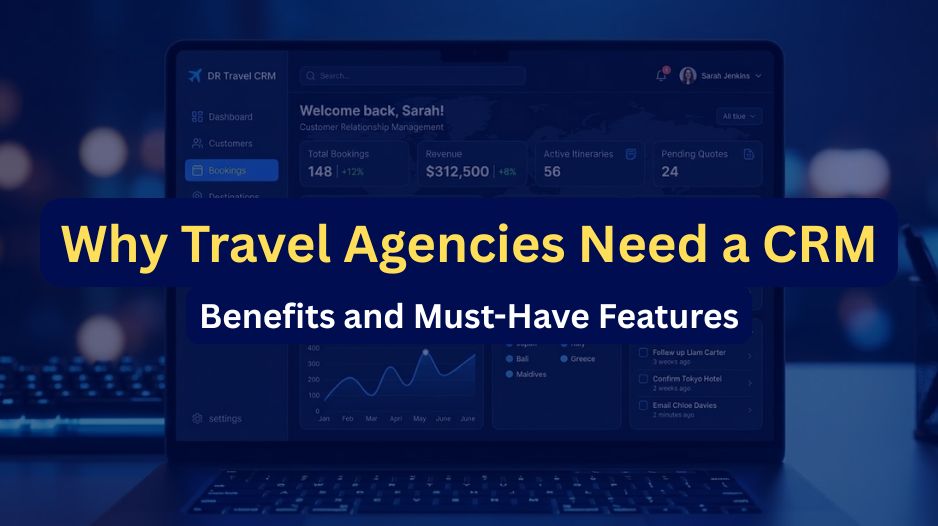
Managing a travel agency is a glamorous business on the surface. Exotic destinations, happy customers, and designed trips — all feel great. However, the truth of the situation is a bit different.
You are responding to dozens of queries on WhatsApp, email, and Instagram, and at times all of them simultaneously. A customer wishes to switch hotels in Manali three days before traveling. The other one has not paid the second installment, and they are flying next week. Your sales executive has just left, and all the client conversations were on their personal phone.
If this sounds similar, you are already aware of the problem.
This is the daily life of most travel agencies in India that do not use a travel CRM. And it is not just exhausting; it costs you money. Late follow-ups, missing leads, delayed payments, and inconsistent client experience silently cost you revenue that would otherwise be yours.
Customer Relationship Management (CRM) software helps bring all this into order. For a travel agency, it is not merely a contact tool but the operational backbone that holds it together. In this post, we will consider why your agency should have it, the advantages it will provide, and which features are worth paying attention to.
What Is a Travel CRM and What Makes It Different?
A travel CRM is not similar to a generic CRM, such as Zoho or HubSpot, in several aspects. Admittedly, a generic CRM is effective, yet it is not entirely congruent with how travel businesses operate in their day-to-day operations.
Now let’s talk about a travel CRM. It is built on your real travel business workflow. It offers functions such as lead management, itinerary construction, supplier coordination, payment tracking, and post-trip follow-ups.
The difference is more than it appears.
A generic CRM takes care of your contacts, whereas a travel-specific CRM takes care of your whole client experience, starting with the initial enquiry about a Goa holiday, and ending with the review they leave six months later.
7 Real Benefits of Using a CRM for Your Travel Agency
So, you are curious to know the benefits of using a travel CRM, right? Well, let’s have a look at the top 7 benefits that you will have with a CRM that is actually built for travel businesses.
1. Every Lead Gets Captured and Followed Up
Think about last month. How many leads did your agency receive? And how many did you actually follow up with properly?
Most travel agencies lose a significant chunk of potential business here. Not because the leads were bad, but because something small went wrong. A WhatsApp message got buried. An email inquiry sat unread over the weekend. A callback was delayed and never happened.
A travel CRM captures leads from every source, like your website, social media, Google Ads, phone calls, and walk-ins. The CRM routes them all into one centralized pipeline. Every inquiry gets logged automatically. Follow-up reminders are set. Your team does not have to rely on memory or scattered notes to know who to call next.
For many travel agencies handling high lead volumes, this single benefit alone typically justifies the cost of CRM within the first few months.
2. You Actually Know Your Clients
The difference between a travel agency a client returns to and one they forget about comes down to one thing: do you know them?
Not just their name and passport number. Do you know they always prefer window seats? That they are vegetarian? That they had a bad experience with a particular hotel chain and would never go back? That their anniversary is in March, and they book a trip every year around it?
A travel CRM stores all of this. Every preference, every past booking, every conversation, every complaint, and compliment is attached to a single client profile that your entire team can access. When that client calls next time, whoever picks up already knows their history.
This is what personalization actually looks like in practice. Not a birthday email. A consultant who remembers what matters.
3. Quotations Go Out Faster and More Accurately
Speed is a conversion factor in travel. If someone is planning a trip to Europe, they are more likely to talk to three agencies simultaneously. The one who responds with a detailed, accurate quote fastest often wins.
Without a CRM, building that quote takes time. You need to pull costs from multiple Excel sheets, cross-reference supplier rates, manually calculate margins, and type it all up in an email. It works, but it is slow, and mistakes often happen.
A travel CRM with built-in costing tools pulls this together automatically. You can automatically calculate accommodation costs, transport, visa fees, and activity charges, with your margin applied. As a result, the quote goes out in minutes, not hours. Multi-currency support also helps when dealing with international clients. In short, you are capable of generating faster quotes with fewer errors and more conversions.
4. Payments Stop Slipping Through
Late payments from clients and delayed payments to suppliers are among the most common cash flow problems travel agencies face. Both are almost entirely avoidable with the right system.
A travel CRM tracks every payment — deposits, instalments, final balances — against each booking. Automated reminders go out to clients before payment due dates. Your finance team gets real-time visibility into what has been paid, what is outstanding, and what is overdue, without having to chase anyone for an update.
On the supplier side, the same logic applies. You know exactly what is owed and when. Strained supplier relationships caused by missed payments become a thing of the past.
5. Your Team Works as One Unit
In many travel agencies without a CRM, client information lives in individual heads and personal phones. When a consultant is on leave or resigns, that information also leaves with them. This becomes a problem the moment someone is unavailable.
A CRM centralizes everything. A CRM centralizes everything. Every client interaction, every booking detail, every supplier conversation — logged, stored, and accessible to your entire team. A client can call on a Monday and speak to a different consultant than they usually deal with, and the experience is seamless because that consultant has full context.
It also protects your business. Client relationships stay with the agency, not with individual employees.
6. Marketing Becomes More Focused, Not Scattershot
Most travel agencies send the same message to everyone, which is not a good practice. Sending the same promotional email to your entire client list is equivalent to shouting into a crowd and hoping the right person hears you.
A travel CRM lets you group your clients properly. A few examples include: families who have booked international trips in the last two years, honeymooners, solo travelers, corporate clients, and clients who have not booked in 18 months. Each group gets communication relevant to them, and the conversion rates reflect it.
Automated campaigns can go further. A client who enquired about the Maldives six months ago but did not book can receive a targeted follow-up when a relevant offer is available. A repeat client approaching their usual booking season can receive an early-access promotion. This is marketing that works because it is timely and specific.
7. You See Exactly How Your Business Is Performing
Many travel agency owners have a rough sense of how their business is doing. A CRM gives you the precise picture.
Which destinations are generating the most bookings? Which sales consultant is converting the most leads? Where in the enquiry process are you losing clients? What is your average booking value this quarter compared to last? Which marketing channel is delivering the best leads?
These questions are unanswerable without data. A CRM surfaces this automatically, through dashboards and reports that give you the visibility to make decisions based on what is actually happening, not what you think is happening.
Must-Have Features in a Travel CRM
Not every CRM marketed to travel agencies is equally useful; they don’t deliver the same thing. Here are the features that genuinely matter.
The Cost of Not Having a Travel CRM
Every travel agency that does not use a CRM is paying a hidden tax in the form of lost leads, inconsistent service, slow quotations, payment delays, and client relationships that do not deepen over time.
The agencies growing consistently in a competitive market are not necessarily the ones with the biggest marketing budgets. They are the ones who have built systems. A travel CRM is that system.
DR Infosoft’s Travel CRM
DR Infosoft has built a Travel CRM designed specifically for how Indian travel agencies operate — with lead management, automated quotations, payment tracking, itinerary building, WhatsApp integration, and reporting built into a single platform.
If your agency is still running on spreadsheets, scattered WhatsApp threads, and your team’s memory, it is worth seeing what a purpose-built system looks like. Explore DR Infosoft’s Travel CRM or get in touch to see a demo. In addition to CRM, DR Infosoft also offers complete digital marketing solutions for travel businesses, including SEO, Social Media Marketing, and website design & development.
Frequently Asked Questions
Q: What is a travel CRM?
A travel CRM is a customer relationship management software created to serve travel agencies. It streamlines lead management, client profiles, quotations, bookings, payments, and communication on a single platform, replacing the spreadsheets and disjointed tools most agencies use.
Q: Can a travel CRM be used in small agencies?
Yes, indeed, small agencies are the greatest beneficiaries. Having a well-structured system will prevent leads from being lost, and clients will be served consistently without relying on the memory of an individual on a smaller team handling large volumes of enquiries.
Q: What is the difference between a travel CRM and a general CRM?
A general CRM manages contacts and sales pipelines. A travel CRM goes a step further, with itinerary building, supplier management, multi-currency costing, travel document storage, and booking-specific payment tracking built in.
Q: What is the time of implementation of a travel CRM?
It is based on the platform and the agency size. A dedicated CRM, such as DR Infosoft’s Travel CRM, can be installed and ready in a matter of weeks, including data migration and staff training.