
Actionable Techniques to Improve Your Website’s Search Performance
Search engines are evolving faster compared to a few years ago. Ranking higher in search engines today demands far more than sprinkling a few keywords on a page. Google gives more weight to helpful content, user experience, and trust signals. AI-powered platforms are also shaping how people discover information. That’s why search engine optimization (SEO) is not merely a one-time fix. It’s an ongoing work that builds visibility over time.
In modern SEO, you don’t need to chase every trend to rank higher. Instead, figure out exactly what your target audience wants, build authority within your niche, and ensure your website is technically sound and user-friendly. Put simply, your website needs to deliver clear, useful answers to user questions.
Today, you need to acquire high-quality backlinks and optimize content for AI-driven search and voice queries. Plus, you need to continuously improve performance. Each factor, every element, is critical to visibility and growth across search engines and AI platforms.
If you go through this blog post, you will find the 10 best SEO practices designed to help you rank higher in search engines. In the end, you will have practical, proven strategies that you can implement to improve search visibility, attract the right traffic, and keep up with competitors in a more sophisticated search landscape.
1. Identify and Understand Your Target Audience’s Search Intent
You want to rank prominently in search engines like Google and Bing. You also want prominent visibility on AI platforms such as ChatGPT, Perplexity, Gemini, and Copilot. That’s great! Everyone has this desire. But how? Many marketers fail here.
The most critical factor that you need to understand is why people search, not just what they type. In this regard, your page should match what people are looking for on search engines or AI systems.
Remember that every search has an intent behind it. Some users want information. Some want to compare options. Others are ready to buy. If your content does not match that intent, it will struggle to rank, no matter how well it is written.
How to match user intent
To match user intent, start by looking closely at your target audience. Think about their problems, questions, and daily challenges. Then search those keywords on Google yourself. Look at the top results. Are they blog posts, videos, product pages, or guides? This way, you will learn what Google believes users want to see.
For example, if most top results are detailed articles, a short sales page will not perform well. If users are searching for a quick answer, a long story will push them away. What do you need to do then? Simply, align your content with expectations.
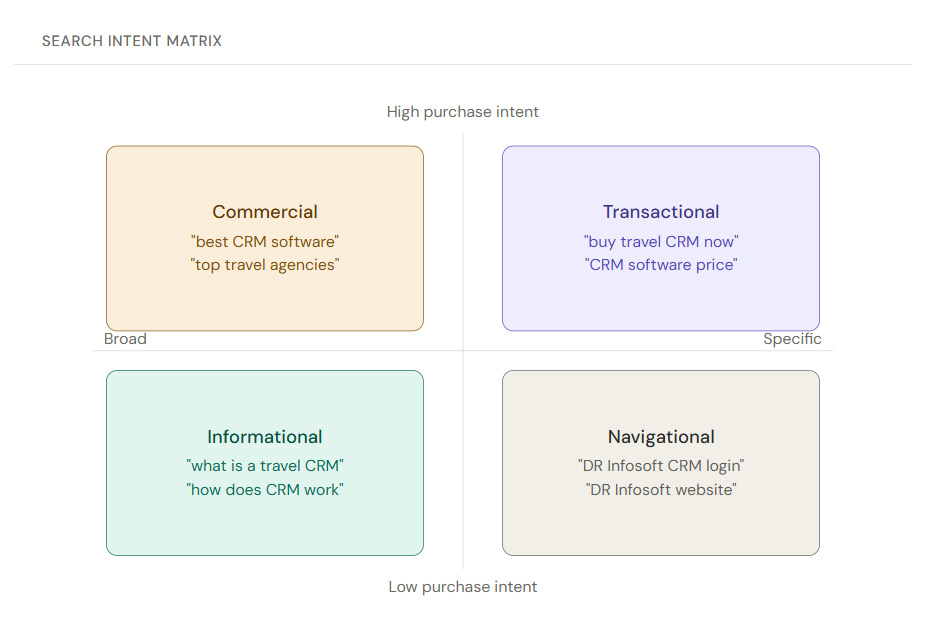
Additionally, pay attention to wording. Words like “how,” “why,” and “what” signal learning intent. Words like “best,” “review,” or “compare” show evaluation intent. When your content speaks directly to the intent, users stay longer, engage more, and trust your site. Search engines notice this behavior. Over time, rankings improve naturally.
If you are not sure about search intent, use Semrush’s Keyword Magic Tool. This tool will let you know the search intent type, such as commercial, navigational, informational, and transactional.
2. Build Topical Authority Within Your Niche
The next important thing that you need to focus on is topical authority. By the way, what do you understand by the phrase “Topical authority”?
Topical authority means becoming a reliable source on a specific subject with high-quality content. You know well that search engines favor websites that cover a topic in depth rather than touch on many topics lightly. When your site consistently answers related questions, Google starts to trust you more.
How to build a topical authority
If you want to build a topical authority, understand your niche properly. Then break your niche into smaller topics and sub-topics. Thereafter, create content that connects naturally. One article should support another; take it seriously. The result? Over time, you will have a strong content network on your website.
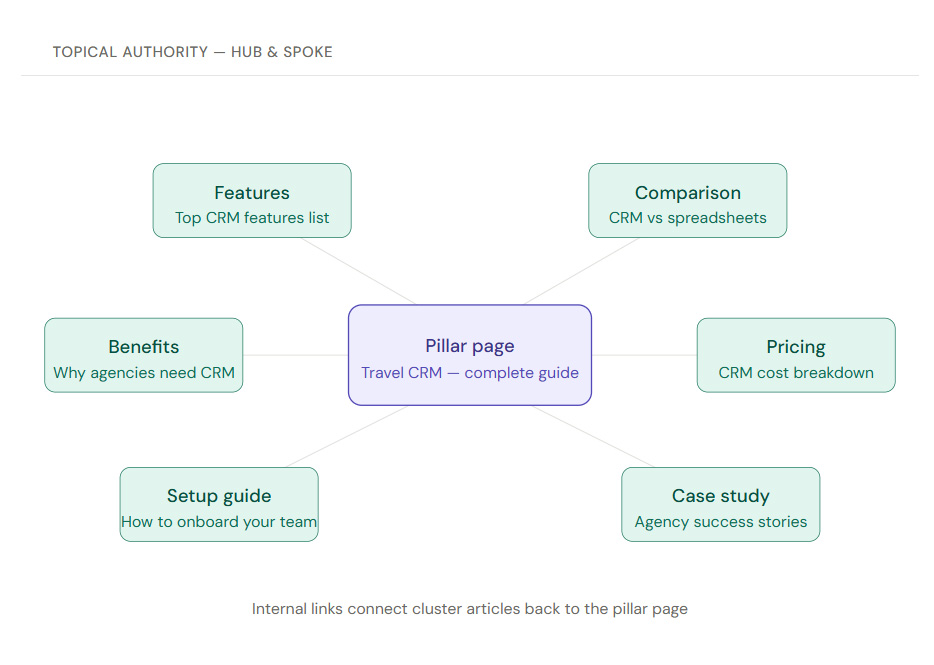
For example, your niche is Packers and Movers. In this case, write about finding the right service provider, moving tips, packing techniques, moving checklist, comparing quotes, and anything that can help the end users. Don’t stop at surface-level advice. Go deeper and answer real questions users ask. Tools like AnswerThePublic, AlsoAsked, and the People Also Ask Section in Google are the ultimate tools to find genuine user queries.
Besides content creation, internal linking is another technique that will help you build topical authority. What you need to do is link related articles together in a natural way. This helps users navigate your site and helps search engines understand content relationships.
Consistency also matters. Publishing one strong article is good. But publishing many connected pieces builds authority faster. What you need to do here is update older content when needed to keep it accurate.
When users see your site repeatedly answering their questions well, trust grows. Search engines follow that trust. Rankings improve because your site becomes a known expert, not just another webpage.
3. Structure Content for Search Engines and AI-Driven Platforms
A clear structure is essential in modern SEO. It makes your content easier for both humans and machines. Search engines and AI tools scan content to understand meaning. If your page is messy, key points get lost. So, you must structure your pages clearly. Here is how you can do that.
How to structure content
Headings
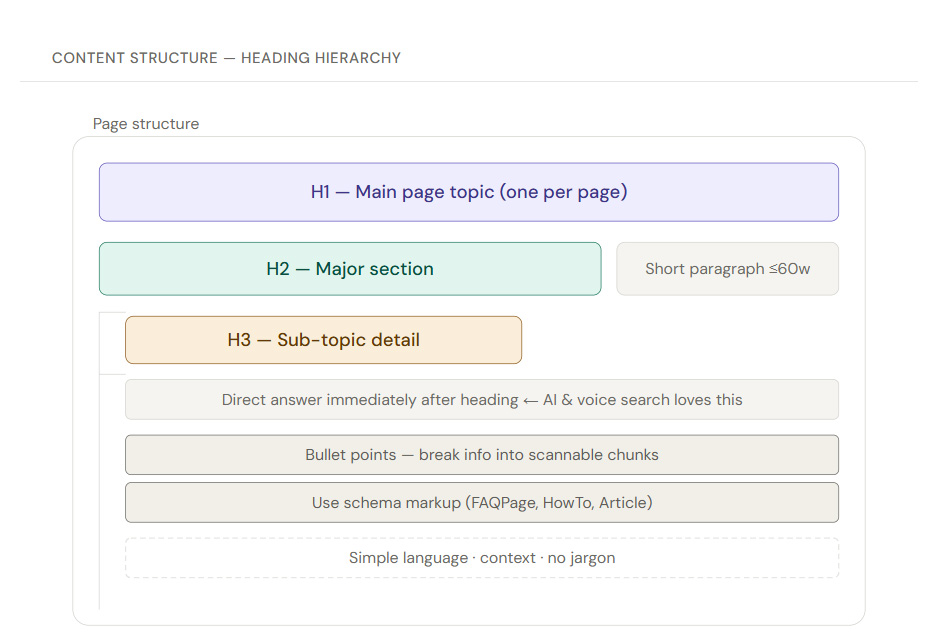
Use proper headings (H1, H2, H3, H4, etc.) but logically. Use one main heading (H1) on your page and make sure it clearly pronounces the main topic. Additionally, also incorporate clear sub-headings, using appropriate tags like H2, H3, H4, etc. H2s break the main topic into several sections, and H3s and lower heading tags support details with key points and examples.
Paragraphs
I have always preferred short paragraphs of 60 words or fewer for my writing. And this works fine for me, and many marketers also recommend this practice, even in modern SEO and AI-driven search behavior. Short paragraphs make your writing easier to understand and help readers stay engaged. This also increases the chances that your content will be included in AI summaries or AI-generated results.
Bullet points & lists
These are helpful when used naturally. They break information into digestible parts. Plus, this increases the likelihood that your content will appear in featured snippets or AI summaries. However, you should do this carefully. Excessive bullet points or lists can reduce the depth of your content.
Direct answers
This is not the new thing. But nowadays, this has become a more prominent and widely discussed topic. What you need to do is directly answer the question of each section after the heading. Don’t hide information deep inside long paragraphs. Clear answers early in the section work best for AI-driven search and voice tools. And Google also loves this practice.
Simple language
Your content should be written in simple language. Complex words don’t improve rankings; clarity does. Write like you are explaining something to a real person sitting in front of you.
Context
Don’t forget about the context; this matters a lot. Explain terms briefly if needed. Plus, use FAQPage, Article, HowTo, and other schema types on your page. This will provide additional context for your pages. This helps AI systems and search engines connect ideas correctly.
When your content is well-structured, easy to scan, and focused, it performs better across traditional search and AI platforms.
4. Implement Strong Technical SEO Foundations
What is technical SEO? Don’t confuse it with on-page SEO. Technical SEO is the foundation of your website. It helps Google and AI platforms discover, comprehend, and properly display your pages. If the foundation is weak, even great content will not save your website. Remember that search engines need to crawl, understand, and index your pages easily; technical SEO ensures all these things in a great way.
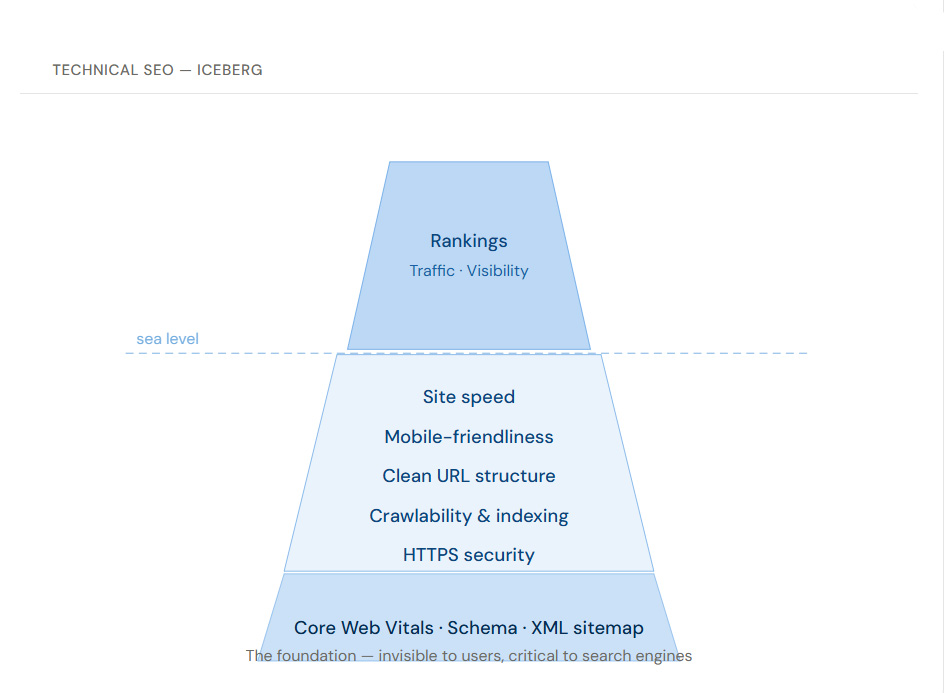
How to do technical SEO
Identify technical SEO issues first. I often use Google Search Console (GSC) and Semrush’s Site Audit Tool to identify technical issues on my websites. Screaming Frog Spider is also a great tool for detecting technical SEO issues. Here are what factors you should focus on:
Technical SEO may not feel exciting. But it quietly supports everything else. When your site is easy to crawl and fast to load, search engines can focus on ranking your content rather than dealing with technical issues.
5. Demonstrate Experience, Expertise, Authority, and Trustworthiness (E-E-A-T)
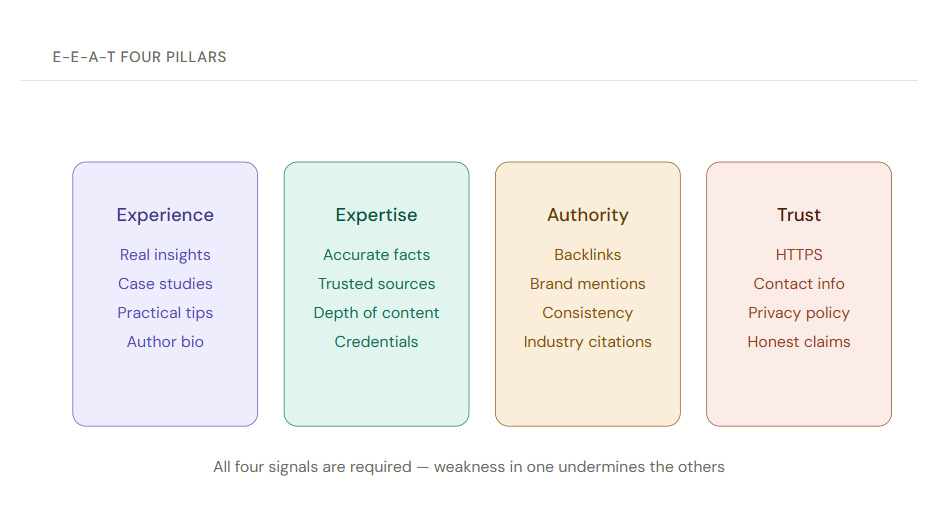
Search engines deeply care about trust. And Google’s E-E-A-T framework helps them decide whether your content deserves visibility. It is especially important to discuss topics that affect money, health, or decisions.
Avoid exaggerated claims. Be honest and balanced in your content. When users trust you, they stay longer and return. Search engines track this behavior. Strong E-E-A-T builds long-term rankings, not short-lived traffic spikes.
6. Optimize Images for Search Visibility and Performance
Image optimization is one of the best SEO practices. It can enhance the visibility of your images across various search experiences. But this is only true when they are optimized properly. Large or poorly named images slow down your site and hurt rankings, too.
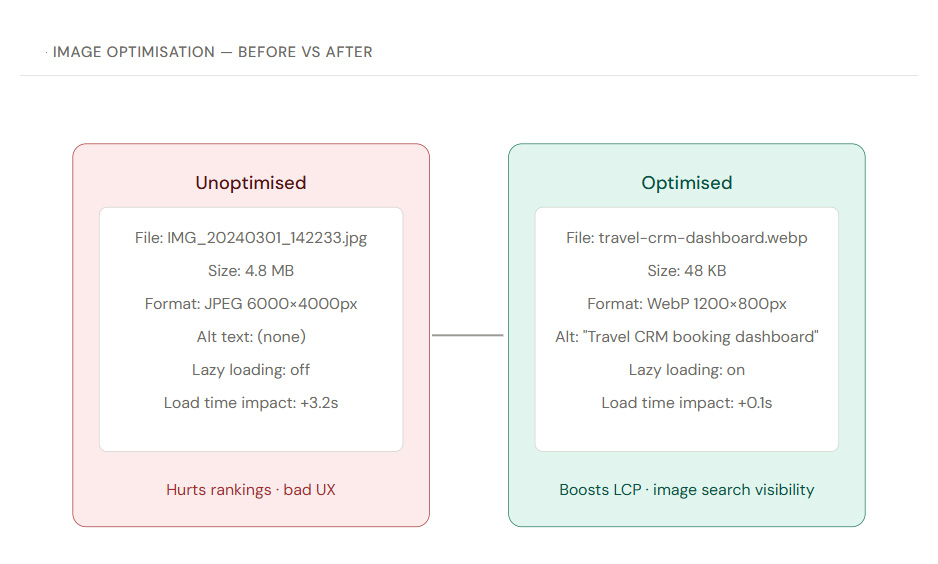
How to optimize images for SEO
Optimized images bring traffic through image search and improve overall page performance. It is a simple step, but many websites still ignore it.
7. Earn High-Quality Backlinks from Authoritative Sources
Backlinks are links from other websites that point to your site. They remain one of the strongest ranking factors, even in 2026. But not all links are equal. Some are really good, while some can be toxic and can hurt rankings. Quality links are highly valuable for SEO because they signal that others find your content helpful. One strong link from a trusted site is more valuable than many weak ones.
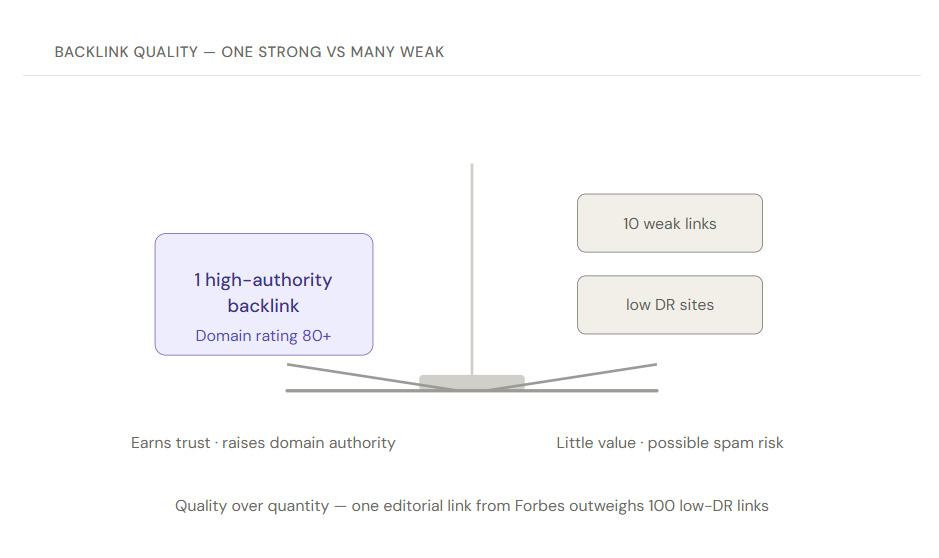
How to earn high-quality backlinks
8. Optimize Content for Voice Search and AI Conversations
More people now search by speaking instead of typing. AI tools also summarize and answer questions directly. Your content should adapt to this shift.
Voice searches are usually longer and more conversational. Users ask full questions. Your content should answer them clearly.
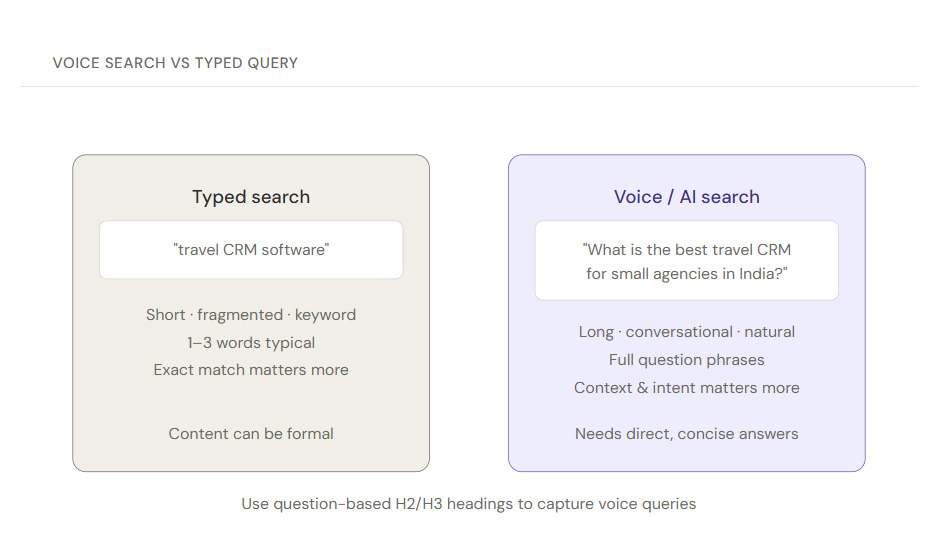
How to write your content to match this shift
9. Track, Measure, and Analyze SEO Performance
SEO without tracking is guesswork. You need data to know what works and what does not. Regularly track rankings, traffic, and user behavior. Look at which pages attract visitors and which ones struggle. This will also help you determine whether your SEO strategy is working and where you need to focus next. I use Google Analytics and Google Search Console (GSC) to see traffic trends and track my strategy. I also use Semrush and Ahrefs for the same purpose.
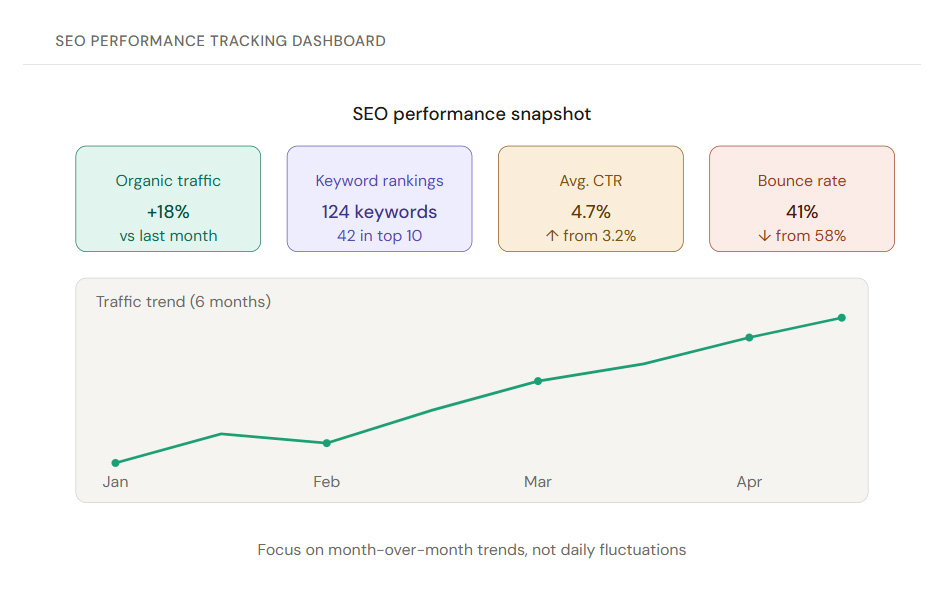
What to monitor and how to analyze SEO performance
When you measure consistently, you make smarter decisions. This keeps your strategy focused and effective.
10. Regularly Update and Refresh Existing Content
One of the best ways to keep your content trustworthy and relevant is to regularly update and refresh it. Older content does not mean that it will not rank. It can still rank very well in search engines if it is relevant. And updating content is also far easier than creating new pages.
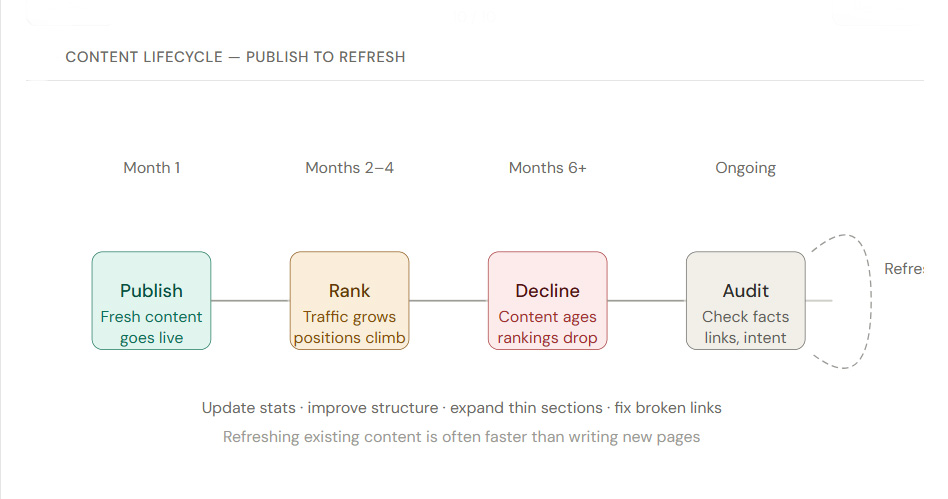
Therefore, review older posts regularly. Check facts, links, and examples, and make sure they are fine. If you find information outdated, replace it with new, accurate information. Here is what you can do.
Search engines like fresh content, but freshness does not always mean new. It means accurate and useful. Refreshing content will make your site more active and reliable. Over time, this habit improves your website’s rankings and keeps it competitive.
Conclusion: Building Sustainable SEO That Lasts
Modern SEO is not about chasing shortcuts. It is not about copying what worked a few years ago. If you are resistant to old techniques, you won’t succeed. Today’s SEO involves building something helpful and reliable. If you focus on end users, search engines will usually follow.
In this blog post, I have talked best SEO practices. Each one plays a vital role in today’s SEO. Some improve visibility, some build trust, and others strengthen the technical side of your website. When you implement these strategies, you are more likely to create a strong and balanced SEO foundation.
You don’t necessarily need to implement everything at once. You can start with understanding search intent and improving content quality. Thereafter, move towards technical fixes, authority building, and performance tracking. Frequent smaller improvements achieve better results than infrequent large changes.
Search behaviors will continue to change. AI-driven search, voice search, and search engine algorithms are already altering how people discover information. Websites that adapt, update content regularly, and stay focused on user needs will continue to grow.
In the end, SEO rewards patience and clarity. If your website answers questions honestly, loads smoothly, and earns trust, higher rankings become a natural outcome rather than a constant struggle.